Archive for March, 2015

Heroic Titanic Engineering Crew

March 27, 2015

The Titanic engineers were the highest paid of the crew.  This reflected their education and technical experience required to operate and maintain the engineering machinery.  The engineer’s pay would have been in the range of £9-£10 per month.

As we know all 25 engineers with ten electricians and boilermakers were lost as a consequence of them remaining below decks in the engine and boiler rooms, battling to keep Titanic afloat.  The self-sacrifice of these men ensured generators continued to function providing power and light till just moments before the ship sank.

13 leading firemen [stoker foremen] and 163  firemen [stokers] were delegated to Titanic whose pay would have been respectively £6.10 & £6.00 per month.  Their shifts would have been four hours on, eight hours off, due to the boiler room’s heat exceeding a temperature of 120 degrees fahrenheit.  What exhausting labour this must have been.

There were 73 trimmers [coal trimmers] who were the poorest paid, £5.10 per month, with also the least desirable job. They worked inside the coal bunkers located on top of, and between, the boilers.  The trimmers’ job was to, with shovels and wheelbarrows, move the coal around the bunker to keep it level, and to shovel the coal down the chute to the firemen below stoking the furnaces.

Finally there were 33 greasers, who worked in the turbine and engine rooms alongside the engineers; they were paid £6.10 per month, and were also responsible for maintaining and supplying oil and lubricants for all mechanical equipment.

White Star’s behaviour towards its employees showed little compassion, and the tragedy did not divert its focus from the bottom line.  Those who survived Titanic found that their pay was computed up to 02.20am on April 15th when the sea overwhelmed the ship.  As for those who did not survive the sinking of Titanic and whose families attempted to access compensation, the White Star Company’s solicitors were diligent in their  attempts to avoid any payment.

A memorial to the 244 engineers, firemen, trimmers and greasers who lost their lives as a consequence of the sinking of Titanic is situated at St. Nicholas Place, Pier Head, Liverpool, the ship’s port of registry.  The memorial was constructed c.1916.  The obelisk memorial stands 14.6m tall and although it is most strongly associated with R.M.S. Titanic, its dedication was broadened to include all maritime engine room fatalities incurred during the performance of duty in WW1.
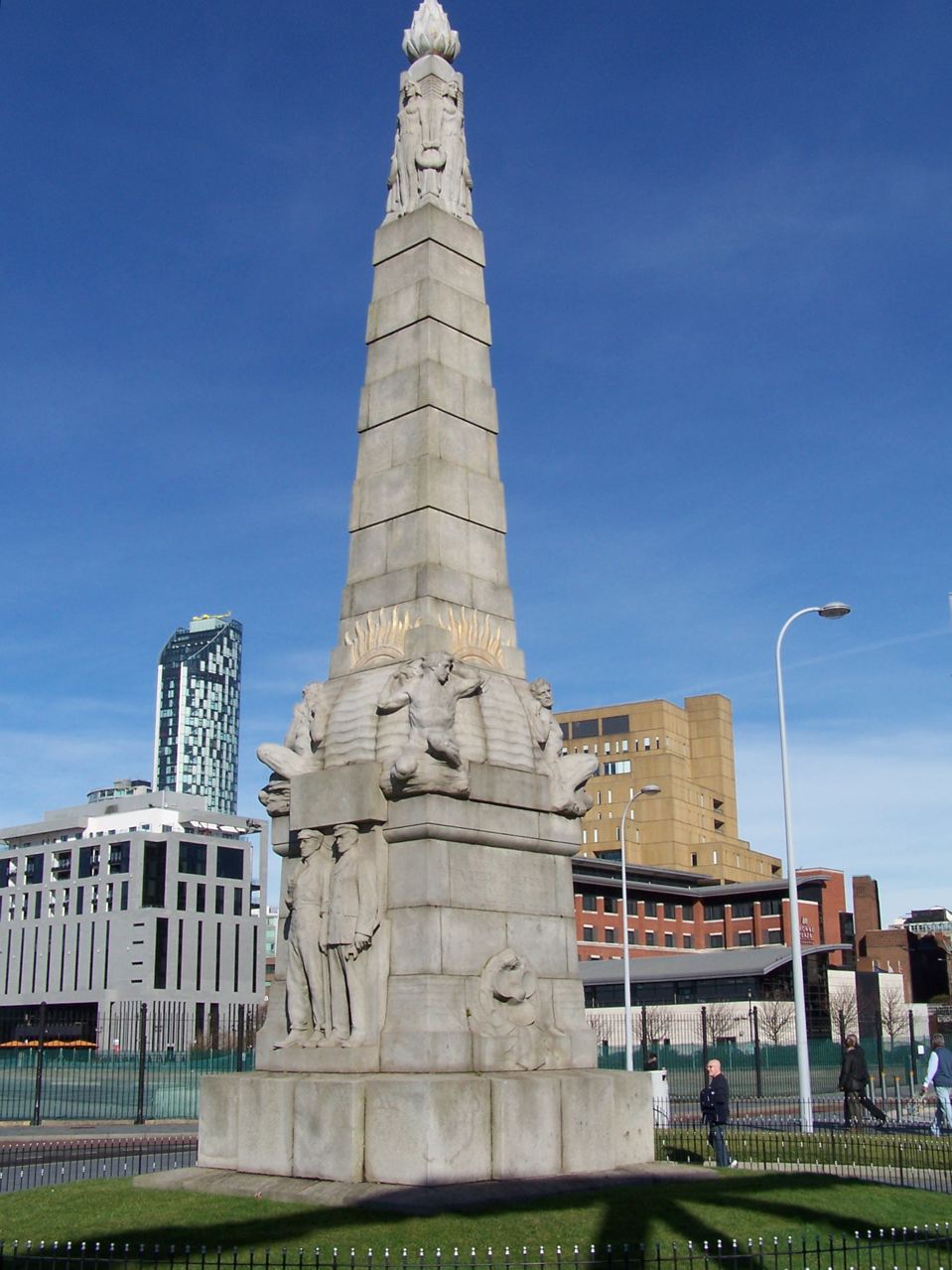
TITANIC OBELISK 1916 TITANIC  MEMORIAL, PIER HEAD, LIVERPOOL
TITANIC OBELISK 1916 TITANIC MEMORIAL, PIER HEAD, LIVERPOOL

103rd Anniversary of Titanic Sinking

March 25, 2015

Next month the 15th of April 2015, marks the 103rd anniversary of the sinking of R M S Titanic and the death of Chief Engineer Joseph Bell.

Since 2012, the 100th anniversary of the sinking of Titanic, the ambition of the ‘Joseph Bell Memorial Appeal’ with donations received from individuals, Trusts, Companies and profits from the sale of our book ‘Tarn to Titanic: Life & Times of Joseph Bell Chief Engineer’, has been to undertake and complete the conservation of the Joseph Bell Memorial Gravestone, situated in the old Churchyard of St Thomas a Becket, Kirkhouse, nr Hallbankgate, Farlam, Cumbria CA8 1JR.

We have additionally established two signposts with attached QR [quick release] plates for accessing this website for further information about Joseph Bell.  We have also introduced a gravelled access footpath to the memorial and addressed the issue of maintenance of the area surrounding it.

With the support of Farlam Parish Trust, we are now able to go forward with the establishment of an information point accessing the graveyard to assist Titanic and family history visitors, in their search for relatives.

Anyone wishing to make a donation to the ‘Joseph Bell Memorial Appeal’ can do so by contacting Barrie Hodgson at bandjhodgson@gmail.com

Titanic supplies

March 19, 2015

Prior to leaving Southampton for Titanic’s fateful voyage, the local traders and others supplied Titanic with an enormous range of provisions that must have been mostly for the passengers’ consumption.  In addition to the supplies of food and drink, there were 57.600 items of crockery, 29,000 pieces of glassware and 44,000 pieces of cutlery.

Here is a not exhaustive list of the supplies:

Fresh meat 75,000 lbs

Fresh fish 11,000lbs

Salt & dried fish 4,000lbs

Bacon & ham 7,500lbs

Poultry & game 25,000lbs

Fresh eggs 40,000

Sausages 2.500lbs

Potatoes 40 tons

Onions 3,500lbs

Tomatoes 3,500lbs

Fresh asparagus 800 bundles

Fresh green peas 2.500lbs

Lettuce 7,000 heads

Sweetbreads 1,000

Ice cream 1,750qts

Coffee 2,200lbs

Tea 800lbs

Rice & dried beans 10,000lbs

Sugar 10,000lbs

Flour 250 barrels

Cereals 10,000lbs

Apples 36,000

Oranges 36,000 Lemons 16,000

Grapes 1,000lbs

Grapefruit 13,000

Jams & marmalade 1,120lbs

Fresh milk 1,500gals

Fresh cream 1,200qts

Condensed milk 600gals

Fresh butter 6,600lbs

Ales & stout 15,000 bottles

Wines 1,000 bottles

Spirits 850 bottles

Minerals 1,200 bottles

Cigars 8,000

Wowee!

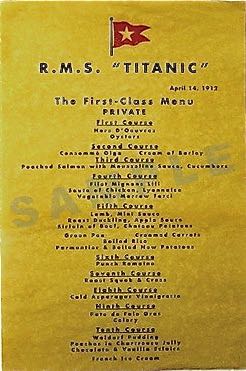
1st Class Titanic menu

Titanic Marconi Message Received But Undelivered

March 8, 2015

The Marconi installation aboard R.M.S. Titanic in 1912 was a great advance in technical progress.  With the installation of the state-of-the-art system, Titanic could communicate with other ships and have messages relayed to one side of the Atlantic or another when in mid-ocean.  Passengers could enjoy the novelty and convenience of sending messages, which was equivalent to sending electronic emails and texts today.

There were two Marconi wireless operators on board Titanic both of whom were trained at the Marconi School at Seaforth Sands, Liverpool.  The senior operator was John “Jack” Phillips and the junior Harold Bride.  The day after Titanic set sail on the 11th of April, it was Jack Phillip’s birthday that was celebrated by them both with pasties brought from the first class dining room.

On the evening of the 14th of April, Phillips was sending out messages to Cape Race, Newfoundland, clearing accumulated passengers’ personal messages.  Soon after 9.30 pm, Phillips received an ice warning from the steamship Mesaba that reported icebergs directly in the bearing of Titanic.

The message was one of the most important warnings received byTitanic, but it was never delivered to the bridge. The Titanic hit an iceberg at 11.40 pm that night and began sinking.  The senior operator Jack Phillips continued sending out distress calls as Titanic was sinking and valiantly transmitted pleas for help until the ship lost power and sank.

Harold Bride the junior operator was a Titanic survivor and arrived in Liverpool from New York on the 18th May 1912. Bride had already made a donation towards the provision of a local memorial for his former colleague Jack Phillips in his home town of Godalming, in Surrey.

Under is an image of the Guglielmo Marconi Memorial Bust situated near Marconi beach Cape Cod, as part of the Cape Cod National Seashore U.S.A.

The memorial inscription reads as follows:

“The Pioneer of Wireless Communication.  Son of Italy.  Citizen of the World.  Born in Bologna April 25,1874.  Died in Rome July 20,1937.  The Hon. Egidio Ortona.  Ambassador of Italy to the U.S.A.  The Hon.John A Volpe.  Ambassador of the U.S.A. to Italy.  Honorary Chairman.  Franco FAA DiBruno.  Consul General of Italy in Boston, Chairman.

MarconiBust Cape Cod 2015