Archive for the ‘Uncategorized’ Category

Titanic Violin for Sale

March 15, 2013
Titanic discovered Violin

Titanic discovered Violin 


Daily Telgraph:

By Telegraph reporters 14 Mar 2013


The wooden instrument used by Wallace Hartley as the band famously played on while the liner sank was thought to have been lost in the Atlantic in the 1912 disaster. It wasn’t until 2006 when the son of an amateur musician who had been casually given the instrument by her violin teacher unearthed it in the attic of her home. The discovery was almost too good to be true, prompting experts to have the relic forensically examined by some of the most revered scientific bodies in Britain.


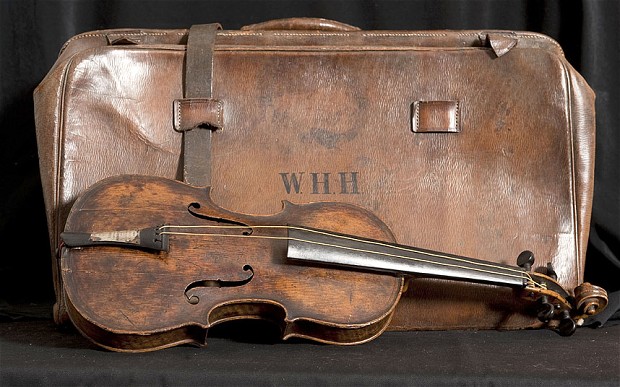
Now, after seven years of testing at a cost of tens of thousands of pounds, the water-stained violin has been proven to be the one played by Hartley on the night of the tragedy. These pictures show how incredibly well preserved the rose wood violin is despite its age and it being exposed to the sea for 10 days after the sinking. There are two long cracks on its body that are said to have been opened up by moisture damage.


The photos also show the corroded engraved silver plate screwed onto the base of the fiddle that provided scientists with they key proof of its authenticity. The historic violin, said to be worth a six-figure sum, will go on public display at the Belfast City Hall, where Titanic was built, at the end of this month. Negotiations are also under way to exhibit it in museums around the world including America. It is likely to be auctioned off in the future.


Titanic experts have described it as the most important artifact associated with the infamous liner to have come to light. Within minutes of Titanic striking an iceberg on April 14, 1912, Hartley was instructed to assemble the band and play music in order to maintain calm. The eight musicians gallantly performed on the chilly boat deck of the Titanic while the passengers lined up for the lifeboats. The band carried on until the bitter end, famously playing a final hymn of ‘Nearer, My God, To Thee.’


Hartley, and the other seven band members, perished along with 1,500 passengers and crew when the luxurious vessel sank at 2.20am on April 15. After his body was recovered by the ship the Mackay Bennett 10 days later, the violin wasn’t listed by officials among the inventory of items found in his possession. A newspaper report later stated that Hartley was found fully dressed and with the instrument strapped to his body. The conflicting accounts gave way to the theory that either the violin simply floated off in the Atlantic or was stolen by somebody involved with handling the bodies.


While scientists spent seven years studying the violin, specialist Titanic auctioneers, Henry Aldridge and Son, and a biographer on Wallace Hartley, meticulously researched the story behind it to discover the truth. Their research appears to show that Hartley actually strapped around him his large leather valise – luggage case – in which he placed his violin moments before the sinking.

One theory is that the bag and wooden item would have aided his buoyancy in the water. They also found the transcript of a telegram dated July 19, 1912 in the diary of Hartley’s grieving fiancé, Maria Robinson, to the Provincial Secretary of Nova Scotia. It reads: “I would be most grateful if you could convey my heartfelt thanks to all who have made possible the return of my late fiance’s violin.” Miss Robinson had given it to Hartley in 1910 to mark their engagement and had it engraved accordingly.


She had requested its return because of the emotional connection with him. Hartley’s personal effects including his silver cigarette case and a gold signet ring were returned to his his father, Albion Hartley. Mr Hartley Snr later gave these items to Miss Robinson, who never married. She kept the jewellery and violin in the leather case as a shrine to her late fiancé. She died from stomach cancer in 1939 aged 59 at her home in Bridlington, East Yorks.


In dealing with her estate, her sister, Margaret, found Hartley’s leather valise that had his initials of ‘WHH’ on and the violin inside. She gave the bag to the Bridlington Salvation Army and told its leader, a Major Renwick, about the instrument’s association with Titanic. The research shows Maj Renwick in turn gave the valise to one of his members, a local music and violin teacher.


In the early 1940s, the current owner’s mother was a member of the Womens’ Auxiliary Air Force stationed at Bridlington.  She met the music teacher who later dispatched the valise and violin to her. A covering letter that has been found states: “Major Renwick thought I would be best placed to make use of the violin but I found it virtually unplayable, doubtless due to its eventful life.” The unnamed owner inherited the valise and its contents, including the violin and jewellery, years later and contacted Henry Aldridge and Son of Devizes, Wilts.


They took the violin to the Government’s Forensic Science Service in Chepstow which concluded the ‘corrosion deposits’ on it were ‘considered compatible with immersion in sea water.’ An eminent silver expert on the council for the Gemological Association of Great Britain studied the plate on the base of the violin. He confirmed the plate was an original fixture on the violin and the engraving was contemporary with the hallmarks on the panel that were made in 1910.


Andrew Aldridge, of Henry Aldridge and Son, said: “When we first saw the violin we had to keep a lid on our excitement because it was almost as if it was too good to be true. “The silver fish plate on the violin along with the other items it was with, such as the leather case with Hartley’s initials on, his jewellery and covering letter to the owner’s late mother, suggested it was either authentic or an extremely elaborate hoax up there with the Hitler Diaries. “We knew we would have to look into it and it couldn’t be rushed. Everything needed to be researched properly and the correct experts had to be commissioned.


“We have spent the last seven years gathering the evidence together and have now reached the stage where we can say that beyond reasonable doubt this was Wallace Hartley’s violin on the Titanic. “One of the most compelling pieces of evidence is the engraved plate which states ‘For Wallace on the occasion of our engagement from Maria.’


“This not only gives us immediate provenance but it has also been shown that the engraving on it was contemporaneous with the 1910 hallmarking. “It also goes some way to explain why Maria Robinson wanted the violin back and why Hartley took it with him into the water. “It is the most important artifact relating to the Titanic to ever emerge and probably the most valuable. “In all the books and films made about the Titanic, Wallace Hartley is always featured as playing this violin until the end.


“We now know that minutes before the end he placed his beloved violin in this hard-wearing travelling case. “The bag rested on top of his lifejacket and would have largely been kept out of the water. A letter from his mother was found in his breast pocket and that suffered hardly any water damage.”


Craig Sopin, 55, a lawyer from Philidelphia, owns one of the world’s largest collections of Titanic memorabilia. He said: “The research has shown that this is something that I would like to have in my collection, which means I believe it to be 100 per cent genuine. “I am satisfied that is the violin that was on the deck of the Titanic. “Popular belief is that the violin was lost or ferreted away but sometimes miracles happen and it has here. “As far as Titanic memorabilia is concerned it is the most important piece that has ever come up and that includes artifacts’ recovered from the seabed such as the crow’s nest bell.”


Hartley, who died aged 34, was from Colne, Lancs, but later lived in Huddersfield and Dewsbury. He was a musician on board the RMS Mauretania and the RMS Lusitania before joining the Titanic at Southampton in 1912. Author and Wallace Hartley expert, Christian Tennyson-Ekeburg has worked alongside Henry Aldridge and Son on the research and has written a new biography on the bandmaster called ‘Nearer, My God, To Thee.’ He said that Hartley carried his violin and bow in a regular case but chose to place the instrument in his valise before the sinking. The bow was too long for the case, which is why it was not found in it when his body was recovered.


Some items of Hartley’s jewellery, including the cigarette case, will be sold at auction in Devizes next month while the violin will be exhibited.


10001 Hits for Joseph Bell

January 9, 2013

The interest in Joseph Bell, his family, sea going career and death on the 15th April 1912 has now just exceeded 10000 viewings.  As a consequence of the viewings I hope that the world now knows much more about him and his life. The 10001 visitors came from 77 countries in all, and the top ten of the countries were:

Country

Views

  United Kingdom

4,081

  United States

1,760

  Canada

1,486

  Ireland

365

  Germany

216

  Australia

209

  France

171

  Brazil

154

  Italy

108

  New Zealand                                            97

Thank you everyone, I hope to add more interesting information about the Bell family during 2013.

New Titanic undiscovered documents for sale

October 31, 2012

Civil servant Maurice Clarke warned that Titanic needed ‘50% more lifeboats’ but his fears were suppressed, a newly uncovered document reveals.  The documents were obtained by a solicitor more than 50 years ago and it is his son who is now selling them with a pre-sale estimate of £30.000.

Titanic safety officer’s warning that they needed ‘50% more lifeboats  

Family Home of Joseph Bell: Audio Walkabout April 2012

October 22, 2012

BBC Radio Cumbria’s Belinda Artingstoll interviewed Ann Freer, currently living in the former Bell family home in Farlam, Cumbria, where Joseph Bell was born in 1861 and lived  his early years here. This audio interview walkabout was part of Radio Cumbria’s marking of the death of Joseph Bell on R.M.S. Titanic, and was broadcast in April 2012.

  • Part 1 of the interview click here
  • Part 2 of the interview click here

Newspaper Report: Marriage of Joseph Bell & Maud Bates 1892

October 3, 2012

Derbyshire Times 30th July 1892

 MARRIAGE OF MISS MAUD BATES OF

RIPLEY 

The marriage of Mr. Joseph Bell, R.N.R. chief engineer White Star Line, eldest son of Mr. John Bell, of Edentown, Carlisle and brother in law to Mr. W H Lowthian, of the Nottingham Joint Stock Bank, Ripley, to Miss Maud Bates daughter of late Mr. Joseph Bates, and niece of Mr. George Day, of the Grange Ripley, has just taken place at Ripley.


The ceremony was performed by the vicar of Ripley.  The bridesmaids were Miss Shawcross of Warrington, Miss Garnham of Ripley, Miss Nellie Day & Miss Gertie Lowthian.  The best men were Mr.John Bell jnr and Mr.W R Bates.  The bride was given away by her uncle Mr. George Day.


The wedding presents were numerous and valuable, and included a tea service and  address from All Saints Church Sunday School teachers, with which Church she had for many years been identified.

Titanic 1st Class Dinner Menu April 14th 1912

September 25, 2012

Francis [Frank] John Bell – Harland & Wolff Apprenticeship

August 31, 2012

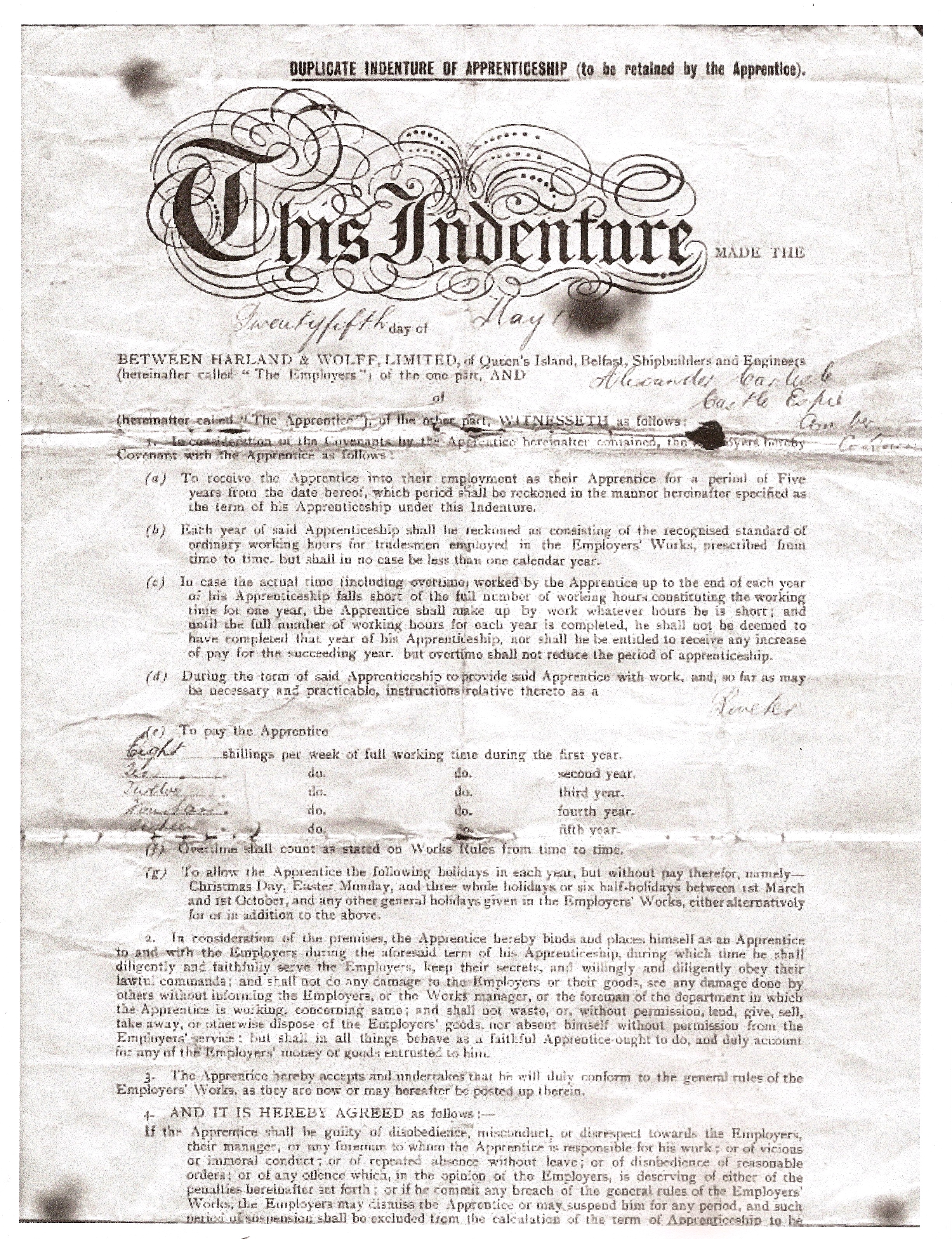
Life for a  young H & W [Harland & Wolff] apprentice like Francis [Frank] Bell was both exciting and demanding in its requirements and conditions in Autumn 1911.  I am unable to confirm if Frank was an ordinary or a  premium apprentice at H & W, but suspect it to be the latter.  Being a premium apprentice would be a ‘shipyard pupil’ whose parent  i.e. Joseph Bell, Chief Engineer on the Titanic at the time, would normally make a payment to H & W and Frank would  consequentially be indentured by them.

Some of the conditions of Indenture were not to damage or waste materials or goods belonging to H & W, neither was fornication, getting married, playing cards, dice, or any other unlawful games allowed.  Visits to taverns, alehouses or playhouses were also out of the question.

The apprentice was paid an initial first year income of 8 shillings a week, with an annual increase of 2 shillings per year if he had been a good lad until the indenture of five years was completed.  H & W were punctilious  about attending work, anyone not attending more than one day without permission was liable to dismissal or fine.  Lastly no liquor or  smoking on the premises – pretty hard going for ten bob a week, but with such assured futures for apprentices in the  H & W world of the period.

See the example of the certificate of Indenture of c.1912:

Indenture Harland & Wolff c.1912


BLUE STAR LINE: Titanic II Project [Updates]

July 7, 2012

19 June 2012

Blue Star Line Chairman, Professor Clive Palmer, today announced one of the world’s leading ship design and marine engineering companies has been commissioned to assist with the Titanic II project. Finnish-based Deltamarin, which has offices worldwide, will undertake a full review of the Titanic II project to ensure the vessel will be compliant with all current safety and construction regulations, as well as meeting the design criteria laid down by Blue Star Line. The work carried out by Deltamarin will enable China’s CSC Jinling Shipyard to begin construction of the passenger liner. Professor Palmer said Blue Star Line had been overwhelmed by the international response to the Titanic II project, which was announced in April this year. “More than 20,000 people have registered on Blue Star Line’s website expressing an interest in receiving regular updates from us or requesting information on how to secure bookings for Titanic II’s maiden voyage,” Professor Palmer stated. He reaffirmed the 2016 launch date for the ship and the intention for Titanic II to sail from China to England before her maiden passenger voyage retracing its original journey. “Titanic II will be a regular feature on the transatlantic route between the UK and USA,” Professor Palmer said. “This magnificent vessel is being constructed in memory of the heroic people who served on the first ship, as well as the passengers who sadly shared their fate. “We also want to recognise the artists and artisans whose skill, creativity and dexterity has never been fully recognised because of the ship’s limited service.” On April 30, 2012, Professor Palmer announced to the world his intention to build and launch Titanic II in conjunction with leading Chinese shipbuilders, CSC Jinling Shipyard. The announcement came 100 years after the original vessel last sailed. Professor Palmer said Titanic II would have the same dimensions as its predecessor, with 840 rooms and nine decks. The main changes to the original Titanic would be below the water line including welding, a bulbous bow for greater fuel efficiency, diesel generation and bow thrusters for increased manoeuvrability. Deltamarin specialise in consulting, design and engineering and project management from small concept development tasks and studies, to complete engineering packages in the marine field. They offer services to the marine and offshore industries worldwide. They were founded in 1990 by a group of naval architects and engineers, some of whom still work for the company. More than 400 people are currently employed by the group worldwide. Their major projects include ‘Oasis of the Seas’, a vast cruise vessel launched in 2009 that can carry over 5400 people. Also on Deltamarin’s impressive list of more than 5000 marine developments are ‘Celebrity Solstice’ and ‘Celebrity Equinox’, two of the most ground breaking cruise ship designs in operation today.

Clive Palmer says new Chinese-built ship will make maiden voyage across Atlantic in 2016

FEBRUARY 2013 

A HUNDRED years after the original Titanic sank, she – or rather, a ship like her – is set to sail again, thanks to one of Australia’s richest men, who has commissioned a replica of the famous passenger liner.

The new version of the ship already dubbed Titanic II, will be custom-built for billionaire Queensland businessman Clive Palmer, who has signed a memorandum of understanding with state-owned Chinese company CSC Jinling Shipyard. The ship is due to make its maiden voyage in 2016.

The 21st-century liner will be an almost exact replica of the original ill-fated ship and will have the same dimensions, with 840 rooms and nine decks. The diesel-powered vessel will also have four funnels, like the original, which ran on coal, but they will be purely decorative.

However, there will be some differences below the waterline. The new ship will feature a “bulbous bow for greater fuel efficiency and diesel generation, and an enlarged rudder and bow thrusters for improved maneuverability” explains the Sydney Morning Herald.

The ship will have a few other features that the original lacked. They include an exhibition room dedicated to promoting tourism in the state of Queensland, and, crucially, an escort from the Chinese navy when it makes its maiden voyage from London to New York in 2016, something that should help it avoid the same fate as the first Titanic.

The original liner was the largest ship of its time. It struck an iceberg on its maiden voyage from Southampton to New York and sank on 15 April 1912, killing 1,500 people.

When asked if the new version of the Titanic would sink, Palmer responded with typical Australian honesty. “Of course it will sink if you put a hole in it,” he said. “It is going to be designed so it won’t sink. But you never know what could happen.”

“Palmer did not provide a cost estimate. He said he had established a new shipping company, Blue Star Line Pty Ltd, and that design work for the Titanic II has begun with assistance from a historical research team,” reported the Daily Mail. ·

Francis (Frank) John Bell, 1919-1930 Service Record [Revised]

May 26, 2012

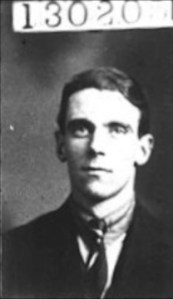
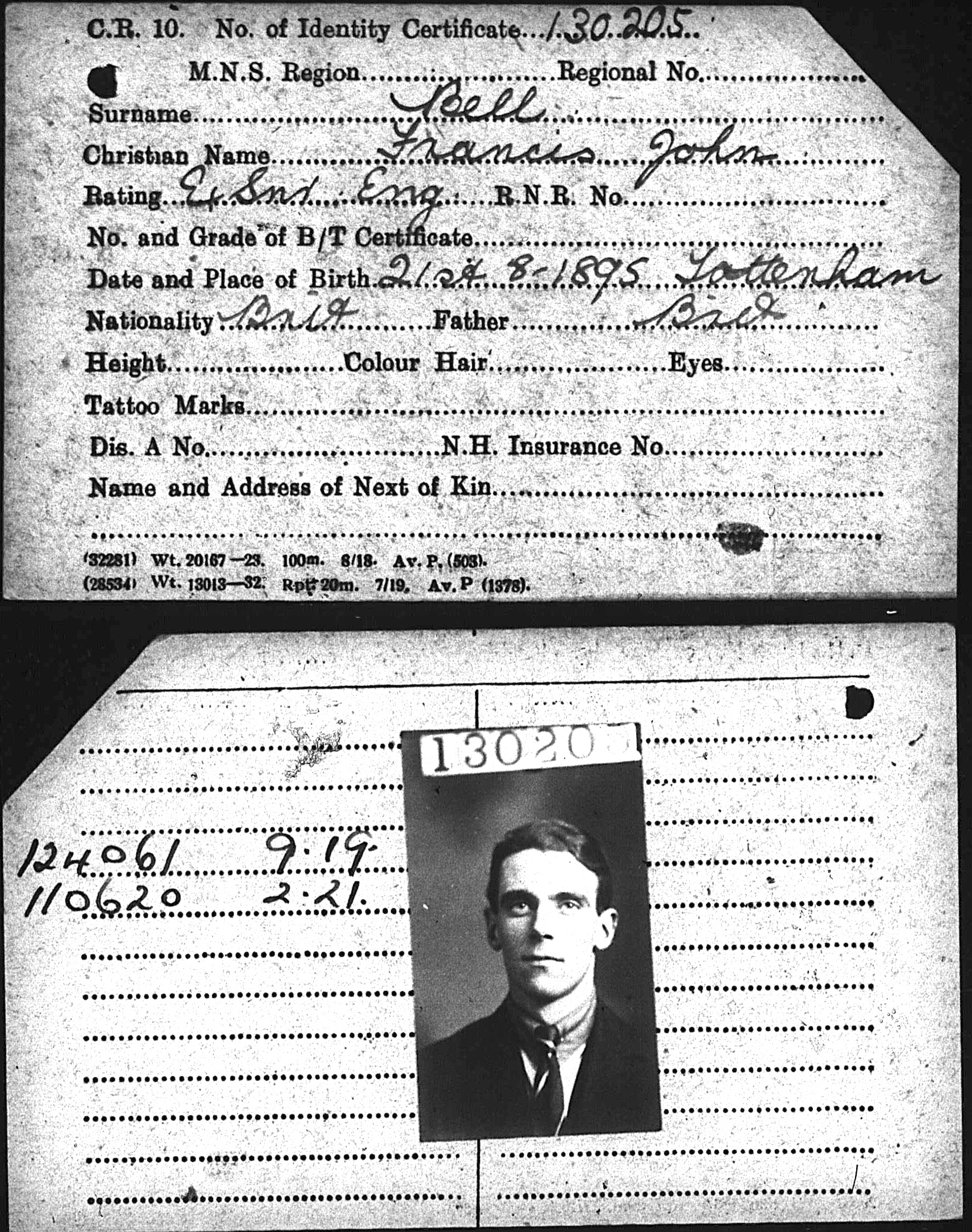
Snr Engineer, Francis John [Frank] Bell, b.21.08.1895 Tottenham London.

Francis John [Frank] Bell – Service Record aged 24 in 1919

This record had to be presented every time he signed onto a ships crew, although this record stops in 1930 it could be due to a change in systems rather than a career change. The first ship listed as 124061 was SS Adriatic he joined the ship in September 1919 and was a 6th senior engineer. On the 29th September 1919 Adriatic collided with the freighter St Michael. Adriatic was not damaged but St Michael sustained some damage to her plates. Adriatic returned to the Southampton service in 1919 till 1922, when she returned to the Liverpool service.  It is recorded that he arrived  as a passenger in New York, and  listed at  [Ellis Island] on the 8th February 1920, his home address was Stockton Heath, Warrington.   From 1926 she was mostly used only as a cruise ship and in 1928 she was converted to cabin class. When Cunard and White Star merged in May 1934, it was decided that is was the end for Adriatic, and at the end of the cruise season was laid up and sold for scrap. The second ship listed as 110620 was SS Persic he joined the ship in February 1921. In 1920 she was refitted to accommodate passengers. Persic was scrapped in 1927. Persic had been requisitioned as a troop transport during WW1, and was torpedoed by a German U-boat thought to have been U-87 off the coast of Sicily, she somehow managed to limp in to port under her own steam. The third ship listed as 145910 was SS Dakotian he joined the ship in April 1922.  The ship was built in 1922 as a cargoliner and on 21st November 1940, the ship struck a mine and sank off Milford Haven, Pembrokeshire, all were rescued.  She had been bound from Swansea for St John, New Brunswick, Canada with a general cargo; 1300 tons of tinplate, Christmas puddings and  bycycles. The fourth ship listed as 145891 was SS Dakarian registered at the port of Liverpool in 1921. He joined the ship in February 1924 as a 4th engineer and the route was Liverpool – Houston. The fifth ship listed as 135476 was SS Scythian registered at the port of Liverpool in 1913.  He joined the ship in June 1924.  The route sailed  was the trans-Atlantic one between Liverpool and New York. The sixth ship listed as 145433 was SS Minnewaska registered in Belfast in 1923.  He joined the ship in July 1928.  The route sailed was London – Boulogne – New York. The seventh ship listed as 144805 was SS Sophocles registered in Aberdeen in 1922, it was renamed Tamaroa in 1926 and sailed on the Southampton – Panama – Wellington service. The eighth ship listed as 149751 was SS Almeda registered in London in 1926 as a refrigerated cargo liner.  Her maiden voyage was from London on 16th February 1927 opening the company’s passenger service  to the River Plate, calling at Boulogne, Madeira, Tenerife, Rio de Janeiro, Santos, Montevideo  and Buenos Aires.  The ship was renamed SS Almeda Star on the 7th May the day before Frank Bell joined the ship on the 8th May 1929 as 4th engineer. The nineth ship listed as 129067 was SS Highland Rover registered in London in 1910. The Nelson Lines who had at least another six ships using the same prefix of ‘Highland’ provided a service to Brazil & River Plate.  The ship accommodated 80 1st, 36 intermediate and 400 steerage passengers.  A cargo of 2000 tons of refrigerated meat, 2000 tons general cargo and space for live cattle.  The ships route was: London-Vigo-Las Palmas-Rio de Janeiro-Montevideo-Buenos Aires. He joined the ship on 25th July 1929. The tenth ship listed as 132559 was SS Highland Piper registered in London in 1920. Another of the Nelson Line ships whose  route was: London-Boulogne-Vigo-Canary Isles-Rio de Janeiro-Montevideo-Buenos Aires. He joined the ship on 29th October  1929. The eleventh ship listed 149981 was MV Dunster Grange registered in London 1928.  The La Plata run was from both London & Liverpool to Montevideo and Buenos Aires. He joined the ship on 14th April 1930. The twelfth  and final ship in so far as is known, was listed as 115268 and was SS Baltonia registered in London in 1927.  The ships routes for the period 1919-1939 were: London to Poland-Latvia-Lithuania and Estonia. He joined the ship on 13th June 1930. The seagoing career of Francis [Frank] John Bell as far as known, began at age 26 in 1919 and ended at age 35 in c.1930 after a seagoing career of 11 years. The research continues….

Joseph and son Frank Bell, from film ‘SAVING THE TITANIC.

Joseph Bell Remembered

May 5, 2012


Whitehaven News

Letters

You Say


HONOURING OUR TITANIC HERO


SIR – Remembering Joseph Bell, chief engineer of the RMS Titanic, who was born in Farlam, near Brampton:


A headstone in Farlam churchyard near Brampton: The headstone marks the death of Joseph Bell from Farlam who was the chief engineer on the RMS Titanic.


He was a grand lad that,

So I eared tell,

A grand lad that,

Aye Joseph Bell.

For when that damn great iceberg struck

An all a t’world’s foundations shook,

He kept that ship alive did he, or

Mare’d a been lost to the crashin sea.

Aye, a grand lad that,

So I eared tell.

God bless his soul, Joseph Bell.


Miss Janice M ROBINSON

Mill Street, Frizington

First published at 11:58, Thursday, 12 April 2012
Published by http://www.whitehavennews.co.uk