Archive for the ‘Uncategorized’ Category

A THANK YOU TO GLOBAL VISITORS TO THE JOSEPH BELL WEBSITE WITH AN EBOOK OFFER

November 10, 2014

Thank You Word Cloud

The 20000 hits on the Joseph Bell website are from 155 countries, of which the top twenty are:

UK, U.S.A, Canada, Australia, Germany, Ireland, France, Poland, New Zealand, Italy, Brazil, Netherlands, Russian Federation, Romania, Belgium, Spain, Czech Republic, Austria & Finland.

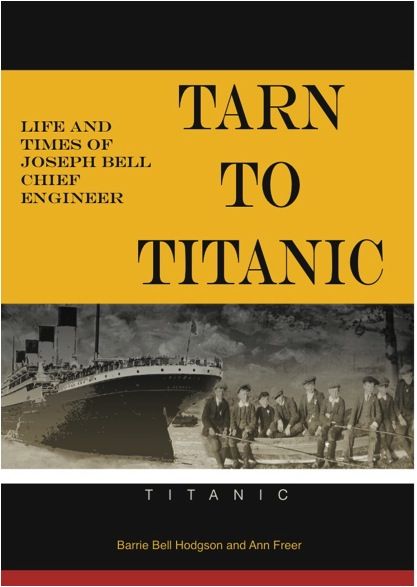
The universal interest in Joseph Bell can be satisfied further for website visitors by accessing the eBook version of the illustrated biography titled, ‘TARN TO TITANIC: Life & Times of Joseph Bell Chief Engineer’ for a donation to the JB Memorial Appeal of £2. The Memorial Appeal is established to honour and maintain the only memorial to Joseph Bell in Cumbria, which is situated not far from what was his family home in Farlam.

You can make your donation by using PayPal see below for details. The offer is time limited until the 31st of December 2014.


T T T cover


The book contains 74 pages on the life of Joseph Bell, the contents includes:

  • Forward
  • Introduction
  • Farlam’s History
  • Bell Ancestry
  • Life on the Farm
  • Coal and Steam
  • School Days
  • Bell to Bridge
  • Continuity with White Star
  • Tributes and Memorials

With approximately 95 photographs and illustrations (mostly in colour), a Bell family tree and copies of original and historical materials from his life, this is well worth a read. The proceeds are for the maintenance of the memorial to Joseph Bell. To receive a copy of the eBook in PDF format, please provide a minimum donation of £2 (GBP) via www.PayPal.com to billh@garden84.net and we will provide a download link by return.

Joseph Bell – sale of the last letter to his son Frank

October 19, 2014

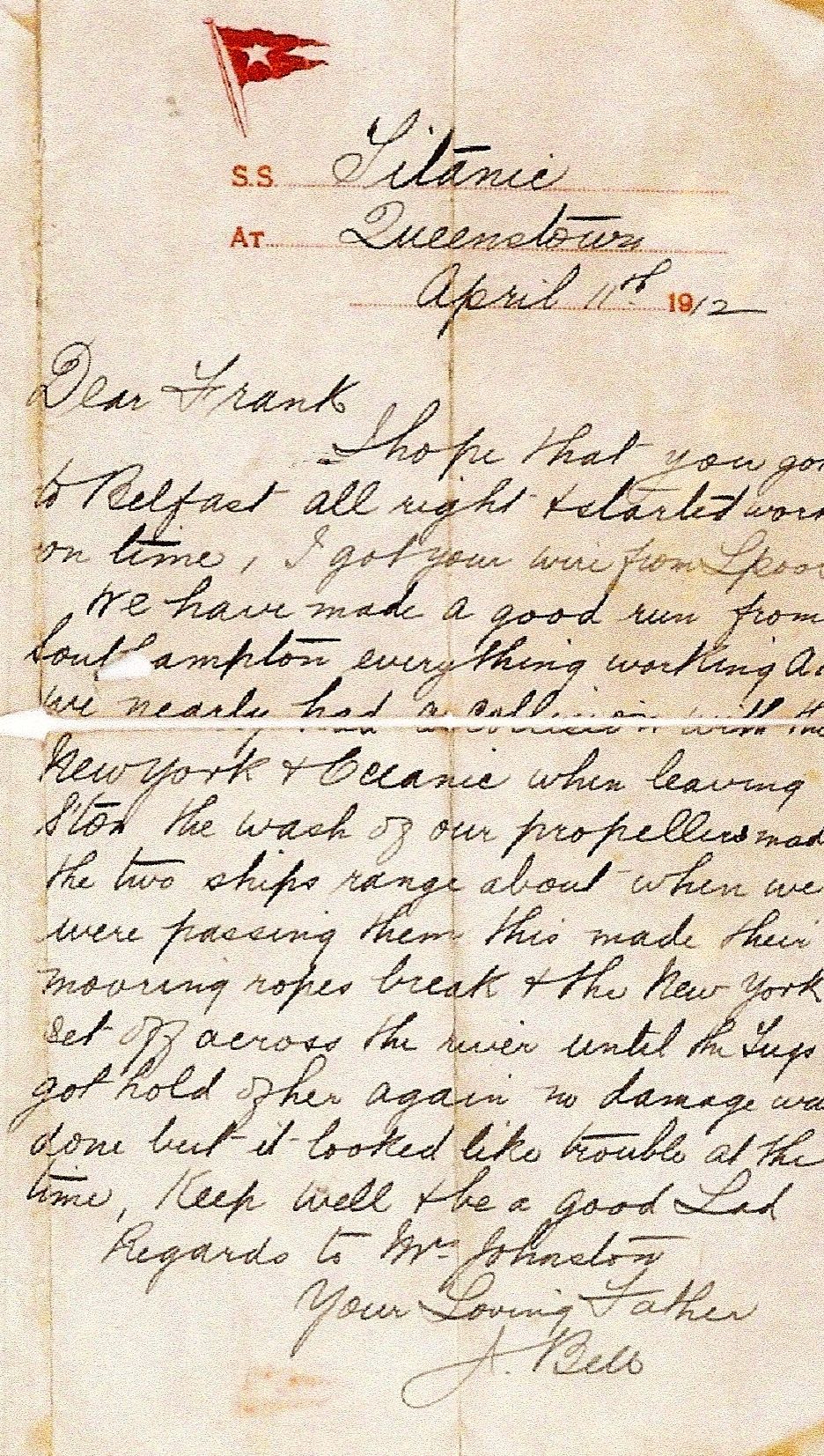
The last letter from Joseph to his  son Frank Bell was sold yesterday, the 18th of October 2014 at Auction.  The letter was sold at above the estimated price for the sum of £24000.00 GBP.  The vendor and purchaser are unknown, but it is to be hoped that one day the letter will be available for all to see in a UK museum.

In addition many other items were sold at auction, including a First Class lunch menu from Titanic dated the 12th of April 1912, it was sold for the staggering sum of £60000.00 GBP.  The menu had belonged to Elise Lurette, a French born maid who was a Titanic survivor.


Joseph Bell – Last letter to son Frank for sale

October 10, 2014

It has been announced that the last letter from Joseph Bell to his son Frank written from Queenstown, in Ireland on the 11th of April 1912, is to be sold by auction in Wiltshire on the 18th of October 2014.  Queenstown-now the Irish port of Cobh, near Cork, was the last port of call for Titanic on her way to New York.

Scan 148

Original White Star Disaster

October 8, 2014
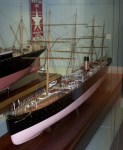
The Clipper RMS Taylor

The Clipper RMS Taylor


John Pilkington, son of the Pilkington Glass Company’s founder Christopher Pilkington, established the White Star Line in 1845. The company originally operated packet sailings to the East Coast of the USA and started using the White Star name in 1849.

When the Australian Gold Rush was underway in 1852, it was estimated that between the years of 1852 to 1857, 226,000 people left Britain to find their fortune in the Australian gold fields. The first vessels of the White Star fleet were chartered sailing ships for the Liverpool to Melbourne route. One such ship that plyed the trade was the White Star chartered iron clipper RMS Tayleur.

RMS Tayleur, a new-iron hulled ship was constructed at the Tayleur & Company’s Bank Quay shipyard at Warrington. She was a little under 2000 in tonnage, had four decks with the capacity to carry around 650 passengers, as well as 1,900 tons of cargo. When she was launched and set sail from Warrington for Liverpool on the 4th of October 1853 there was much celebration and pride expressed by the local community. She subsequently made her maiden voyage from Liverpool to Melbourne Australia, on the 19th of January 1854, with 652 passengers and crew.

On leaving Liverpool on her maiden voyage, it became apparent when leaving the Mersey that the ship’s compass readings were not accurate, and became particularly clear when she hit very rough weather. It became almost impossible for the crew to steer the ship and instead of travelling south, the ship was travelling west when the gale blew up and she found herself off the coast of Ireland, at Lamby Island, north of Dublin Bay, where she foundered after hitting rocks with the loss of 372 lives. Anchors had been weighed but the line broke resulting in her being dashed against the rocks. Some passengers scrambled with much difficulty onto the rocks and survived, but many families having left Liverpool with so much ambition for the their futures, disappeared below the waves on the 21st of January 1854.

The disaster, of which we now know White Star had more to come, was by the Board of Trade stated to have been caused by the iron hull affecting the ship’s compasses causing them to be read incorrectly. The rudder also was a new design that had not been adequately tested on this type of ship.

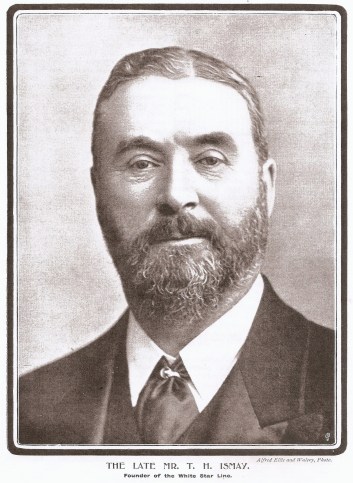
It was in 1867 that Thomas Henry Ismay, aged 30, purchased the old White Star Line from the managing owner of the existing fleet of mostly wooden clippers, with the intention to progressively move forward to constructing ships made of iron only. This was the beginning of the special relationship with Harland & Wolff the Belfast shipbuilder, who built so many ships for the White Star Line. It was the same decade that Joseph Bell, Chief Engineer of the RMS Titanic was born – on the 12th of March 1861, also the American Civil War began in April 1861 and hostilities continued until 1865.

Innovator of the White Star Line: Mr Thomas Henry Ismay

October 5, 2014

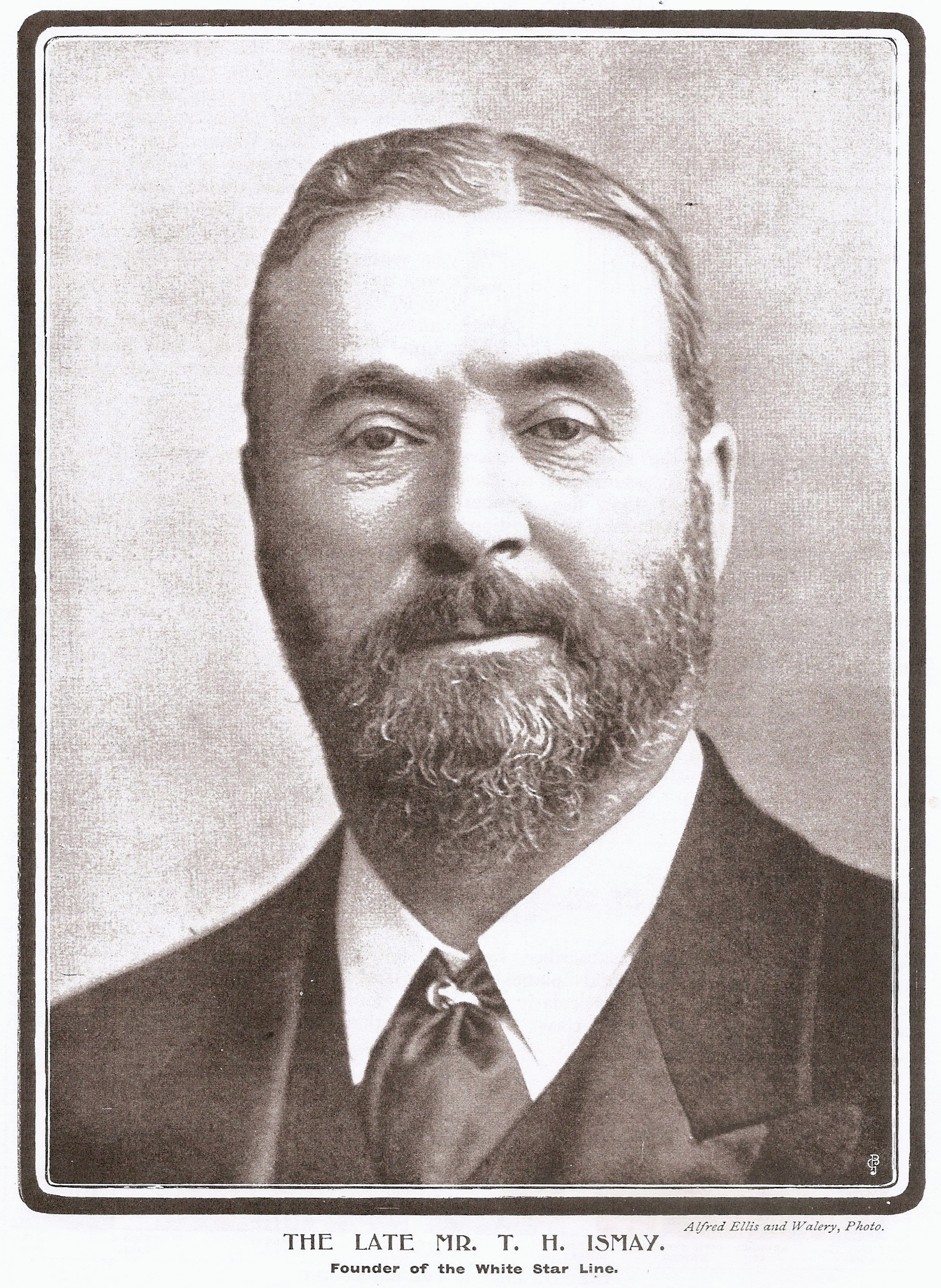
Thomas Henry Ismay


A Great-grandson of Thomas Henry Ismay, Mr Michael Manser, recently bought a copy of our biography of Joseph Bell ‘Tarn to Titanic’. He kindly supplied me with details about his Great-grandfather T.H.Ismay who was the founder of the White Star Line. and son of Cumberland boatbuilder, born 7th January 1837 and died 23rd November 1899. He was able to secure an interest in a fleet of boats, and out of that he built up the splendid service of steamers known in all parts of the world. On his death in 1900, he left the great fortune of £1,297,887; this sum in 2014 terms would be equal to the sum £139,288,583.90.

The White Star Line was very reflective of Great Britain’s expansion of maritime commerce; the line owes its success mainly due to the business genius and thoroughness of one man – Thomas Henry Ismay who laid the foundation of its fame and enabled the White Star flag to extend its sway over the seas of the world. The rise and development of the White Star fleet are so closely interwoven as to be inseparable.

After schooling in Carlisle in 1837 aged 16, and mastering as much of the shipbuilders art at his father Joseph Ismay’s Maryport shipyard could offer, Thomas left there for a wider field of experience and went to Liverpool. During the mid fifties Mr Ismay entered the firm of Imrie, Tomlinson & Co as ship-owners and shipbrokers in Liverpool. After the completion of his indentures where he gained much experience and trust, he travelled, sailing round Cape Horn and visiting Chile, Peru, and Bolivia. It was said his motto was, then and always,” Be mindful”.

Liverpool at this time was in the throws of commercial expansion with many well-established shipping companies who controlled much of the shipping, but still offered the opportunities for further trading from Liverpool to overseas destinations. Mr Ismay’s opportunity came at aged 30, in 1867, when the managing-owner of the old White Star Line retired. He bought the White Star Line flag and goodwill together with their Australian wooden clippers, White Star & Blue Jacket and other sailing vessels.

In the following year of 1868, T H Ismay with a former apprentice, Mr William Imrie, formed the Ocean Steamship Company; Ismay then began to make the changeover to steam from the wooden sailing ships he owned. When the American service commenced in 1870, the naming of “White Star Line” was associated with it. Much progress was made expanding the passenger steamer fleet in partnership with Harland & Wolff, the ship builders, who received the sum of £7,000,000 from White Star for their construction. The White Star flag – the red swallowtail, with the five-pointed star in the centre is to be seen flying above the funnels of the great iron steamers. The White Star ships had heretofore been employed exclusively in the Australian trade, but Mr Ismay saw no reason why the vessels under his command should not steam westward, as well as southward across the North Atlantic, and the South Pacific. In due course the White Star fleet were making regular voyages between Liverpool and New York.

The first White Star steamer of the Atlantic fleet, the Oceanic was launched on the 27th August 1870, with best of officers and men that were available. When the Oceanic made her first round voyage to New York and back, in March 1871, Mr Ismay accompanied her. When he returned to Liverpool elated, the word was given to proceed as fast as possible with the building of additional steamers.

In the year following the foundation of the new company, Mr Wm Imrie, of the former firm of Imrie, Tomlinson & Co in whose office he and Mr Imrie had been fellow apprentices, joined Mr Ismay in the management. The firm then took the title of Ismay, Imrie & Co. Mr Ismay was the leading figure from 1867 to 1899. a period of thirty-two years.

In partnership with Harland & Woolf’s shipyard in Belfast the White Star fleet grew; The Oceanic was quickly followed by the Baltic,Republic,Adriatic and Celtic; and in 1874-5 two larger ships, the Britannic and Germanic were built. Following these came the Arabic, Coptic, Ionic, Doric, Gaelic, Belgic, Cufic and Runic. In 1889 and 1890 the mercantile armed cruisers Majestic and Teutonic were launched; in 1891 and 1892 the cargo and live-stock steamers Nomadic,Tauric and Bovic; in 1893 the Gothic, a twin-screw passenger steamer for the New Zealand service; in 1894 and 1895 the Cevic and Georgic, twin screwed cargo and live-stock steamers for the Liverpool and New York trade.

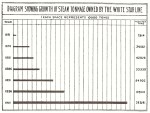
Later additions to the White Star fleet were the Oceanic [2], and the Celtic, the former a vessel of 17,274 tons launched in 1899, the latter, a still larger steamer of 20,904 tons, sailing on her maiden voyage in the summer of 1901. Another great steamer, the Athenic, is almost ready for taking its place on the Atlantic service, and two more – the Corinthic and Ionic are to be launched during 1902. To date the twenty-eight ships of the White Star Line represent a total tonnage of approx 226,000 tons.

In 1887 Mr Ismay offered to place the whole of the White steamship fleet, being the swiftest vessels afloat at the disposal of the Government for service as cruisers or transports in the event of war. Mr Ismay in celebrating Queen Victoria’s Jubilee in 1887 and his fiftieth birthday, gave £20,000 to found a pension fund for old and worn-out sailors. In commemoration of the founding of the fund, the Mercantile Service Association, who also had his portrait painted for their rooms, presented Mr Ismay with an illuminated address. He was one of the founders, and for over twenty years acted as chairman and treasurer of the training ship ‘Indefatigable’, the only institution of its kind in Great Britain for the training of orphans of sailors and other destitute boys for the sea, since its formation has been the means of educating and giving a start in life to more than two thousand poor lads.

Mr Ismay was loved and trusted, and much of his success was due to his capacity of surrounding himself with good and capable men and treating them well. In 1885 the shareholders of the White Star Company, anxious to acknowledge in some prominent way their obligations to Mr Ismay for his energetic and successful management of the business, presented him with a valuable service of plate and a portrait of himself painted by Millais. In 1891, after forty years of business life, Mr Ismay retired from the firm of Ismay, Imrie & Co, but continued to control the destinies of the White Star Line as its chairman until his death, having died at his home at Dawpool Hall, near Thurstaston, of a heart attack following a serious illness on the 24th of November 1899.

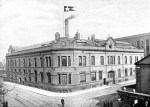
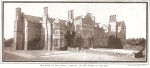
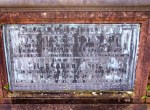
The family sold the Ismay home at Dawpool Hall, Thurstaston, on the Wirral, on the banks of the river Dee in 1907. Dawpool was subsequently demolished in 1927. The gravestone of Thomas Henry Ismay and his wife Margaret was designed by R.Norman Shaw, who was also the architect of the White Star office building in James Street, Liverpool. It is situated in the churchyard of St Bartholomew’s Church, Thurstaston, the inscription on the tombstone reads:

Sacred to the memory of

THOMAS HENRY ISMAY

Who died fully trusting in God’s mercy on November 23rd 1899 in the 63rd year of his age

 “Great thoughts, great feelings came to him

Like instincts unawares”

Also of his wife

Margaret Ismay

who passed away in the same trust on April 9th 1907 in the 70th year of her age

Blessed are the pure in heart for they shall see God


Bell Family Tree Revised

August 7, 2014

Please see the new six people that have been added to the Bell Family Tree, by click here.

Mike Arnott re-enacts his Great, Great, Great Grandfather’s rowing success of 1851

August 7, 2014

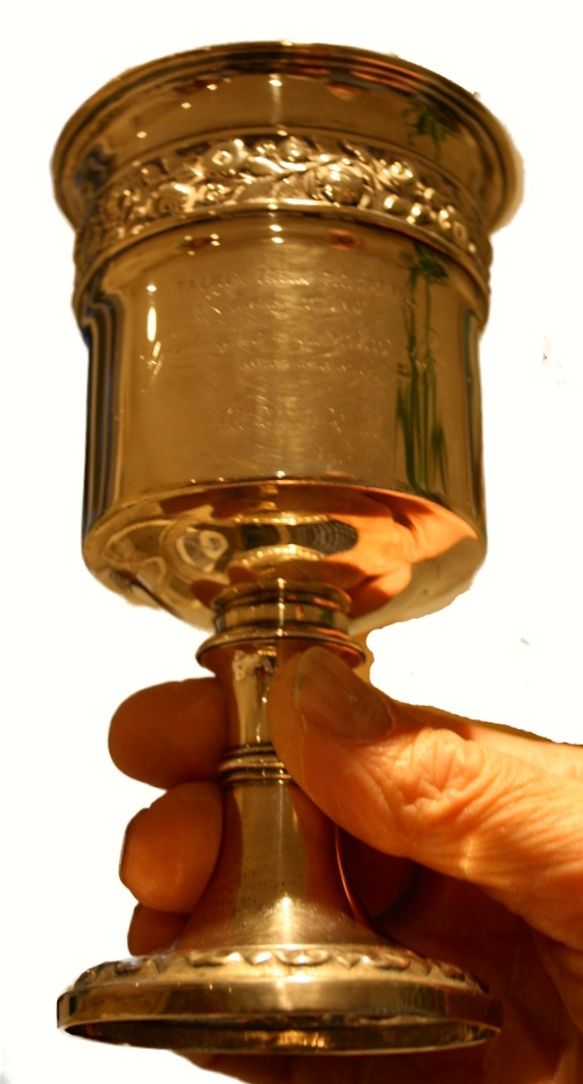
The silver cup as illustrated below was won by John Bell, father of Joseph Bell at the annual Talkin Tarn Regatta of 1851.  The cup  is inscribed with the words “TALKIN TARN REGATTA AUGUST 22ND 1851 Gentlemen’s Amateur Prize 4 oared race won by Mr John Bell”.  Mr Michael Arnott, whose mother is the youngest daughter of John Bell Lowthian, competed in this year’s 2014 Regatta and attempted to emulate his Great, Great, Great Grandfather John Bell’s success of 1851  although unlike his GGG Grandfather  was unable to win the cup. Mr Arnott is the rower with the cap in the image below.

Talkin Tarn Cup


rowers


Mr Wayne Ranger and his Titanic Family Survivors

July 16, 2014

Thomas Ranger was born on 10 December 1882 in Northam, Southampton, Hampshire, England, the son of George William Ranger (1848-1909), a coal porter, and Ann (nee Ashbolt, [1854-1902). He had nine known siblings including: Mary Ann Ranger (1873-1923), Ellen Louisa Ranger (1875-1941), George W Ranger (1875-1959), Elizabeth Maria Ranger (born 1878), Kate Ranger (born 1889), Fanny Ranger (born 1890) and Beatrice Lucy Ranger (1893-1976).

Thomas joined the Royal Navy as a stoker and in 1901 was listed in the census aboard the Duke of Wellington, in Portsmouth Harbour.

In 1906 he married Isabel Pendry (1882-1947).  In the 1911 census he was listed as a house builder bricklayer living with his wife at 81 Middle Road, Sholing.  He gave this same address when he signed on to RMS Titanic as a greaser on 6 April 1912.

Thomas was in the electrical workshop above the turbine room. 2 minutes after feeling the shock from the impact with the iceberg, he noticed the turbine had stopped. He survived the foundering of Titanic by crawling out of a funnel and finding lifeboat 4. He was rescued from the sinking in Lifeboat 4,together with the other occupants who were, after many hours, picked up by the SS Carpathia, and taken to New York, and subsequently to London.

Thomas Ranger, forefather of Wayne Ranger gave his Testimony with an Examination on day 5 of the British Wreck Commissioners inquiry in London.

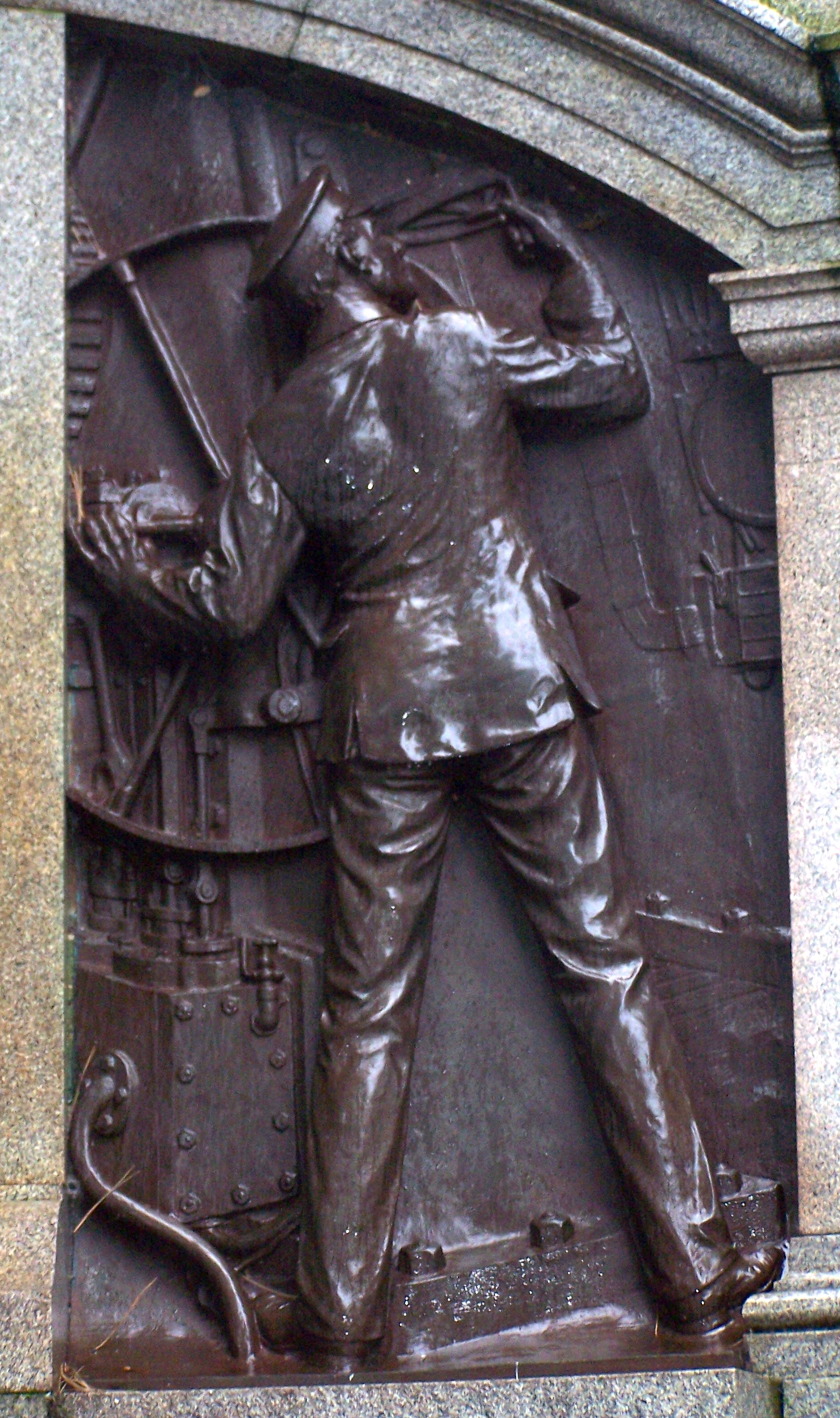
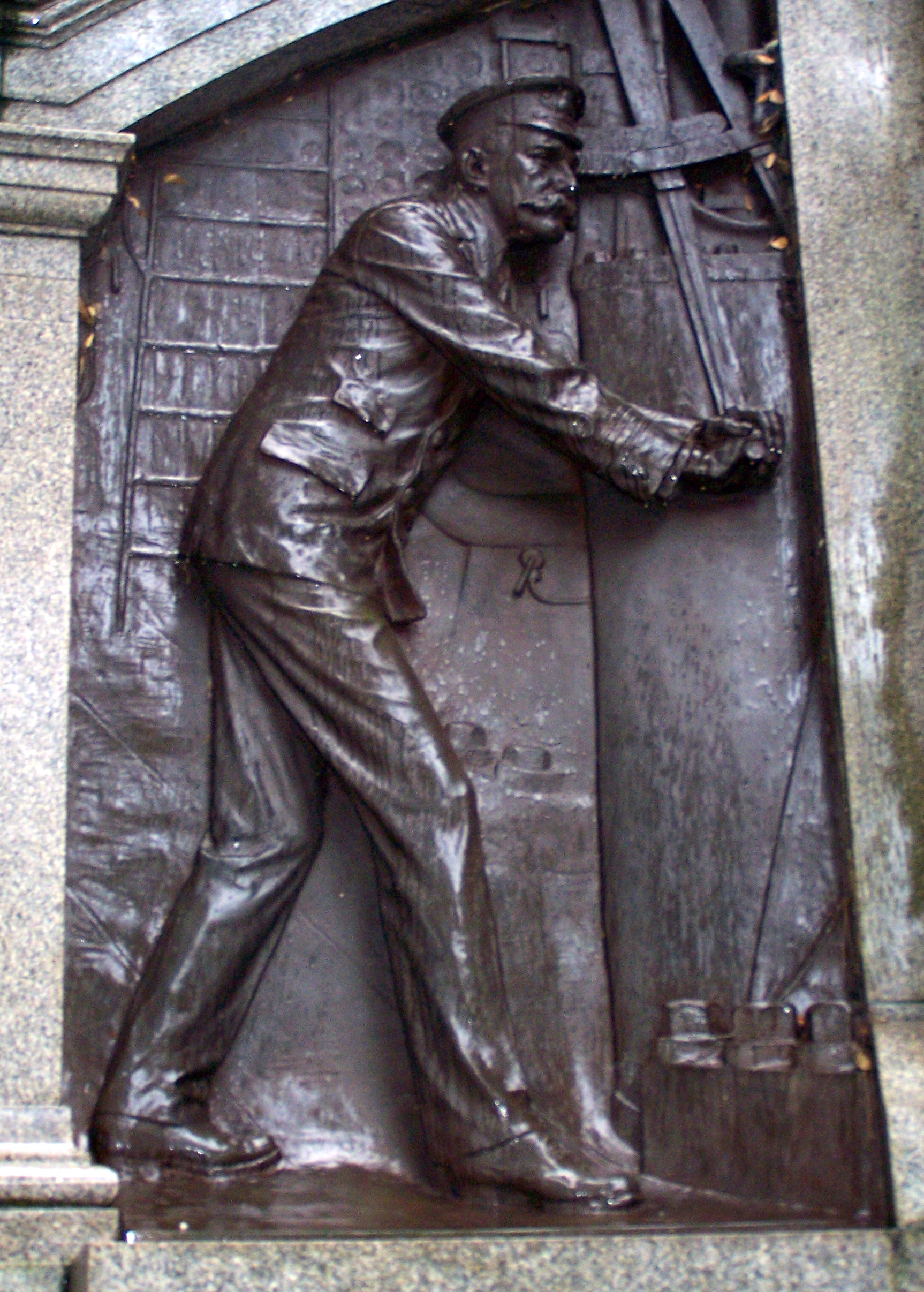
A  relative of Wayne Ranger was Charles Frederick William Hatfield, born c.1879 in Southampton. Charles spent most of his life below decks in engine and boiler rooms as a stoker and greaser. Subsequent to the foundering of RMS Titanic, Fred, as he was known, was chosen by the White Star Line to be a model for the Titanic Engineers Memorial in Southampton, sculpted by Ferdinand Victor Blundstone, that was unveiled on the 22nd of April 1914.  See sections below modelled by Fred from The Titanic Engineers Memorial, Southampton.

100_4759 100_4760


Latest Joseph Bell Family Connections:

July 14, 2014

As a consequence of our illustrated biography of Joseph Bell ‘Tarn to Titanic’, two daughters of John Bell Lowthian [1891-1962], a nephew of Joseph Bell, his wife being Winifred nee Bates, contacted me to express their pleasure in their re-discovered relationship with Joseph Bell of Titanic.

John Bell Lowthian’s eldest daughter, Leonora Mary, was born in 1921, and recently made a handsome donation to the Joseph Bell Memorial Appeal. This will be used towards the provision of an information point to be established at the churchyard entrance to the Joseph Bell Memorial in the old churchyard of St Thomas a Becket near Farlam, Cumbria. Leonora expressed affectionate memories of the four children of Joseph Bell.

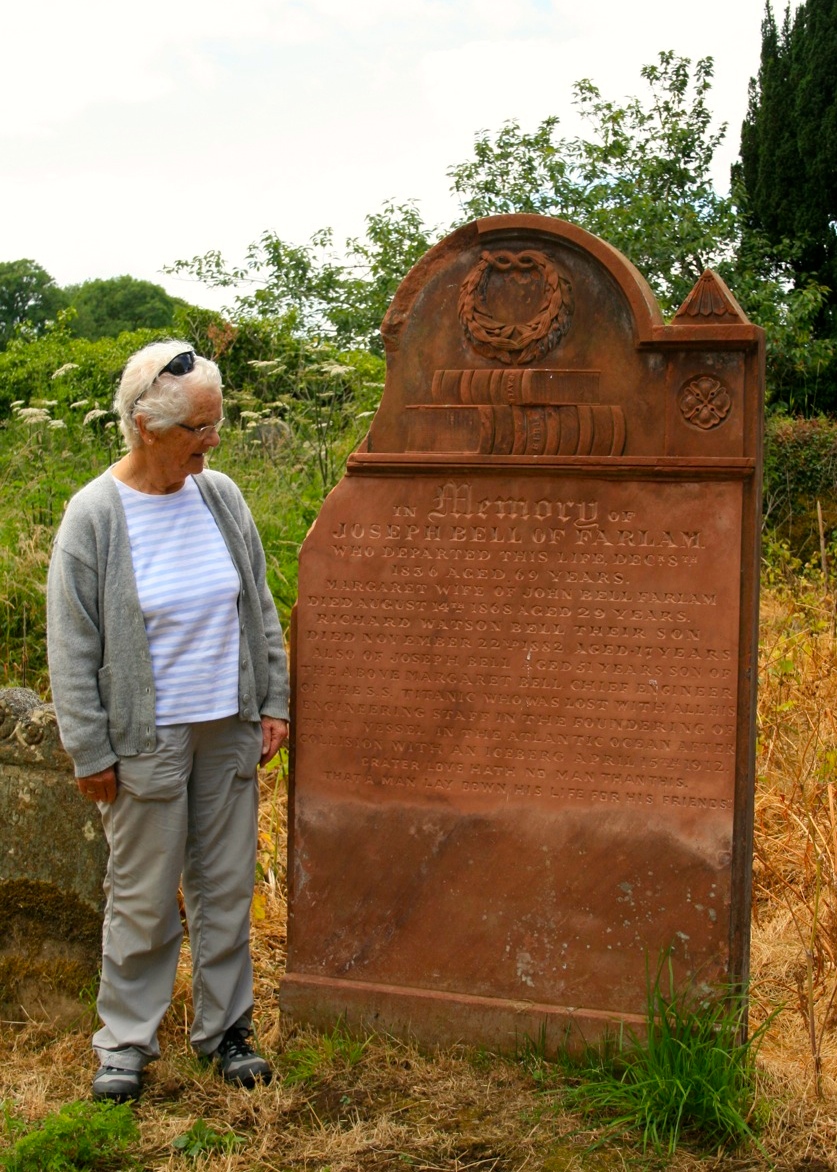
The youngest daughter of John Bell Lowthian, Christine Margaret, who was born in 1925, did on a recent visit to Farlam for the annual Talkin Tarn Regatta visit the Joseph Bell memorial gravestone, below is an image marking this special occasion for her.


Mrs Arnott d. John Lowthian Bell

Maritime Executive: Titanic Engineer’s Memorial Headstone Rededicated

May 22, 2014

Further coverage of the unveiling of the restored headstone for Joseph Bell can be seen over at the Maritime Executive site, by clicking here: http://www.maritime-executive.com/article/Titanic-Engineers-Memorial-Headstone-Rededicated-2014-05-19, which covers the story from top to toe on the research into Joseph’s past, the book that was published, and the ceremony on the day to reveal the renovated memorial and surrounding area.